
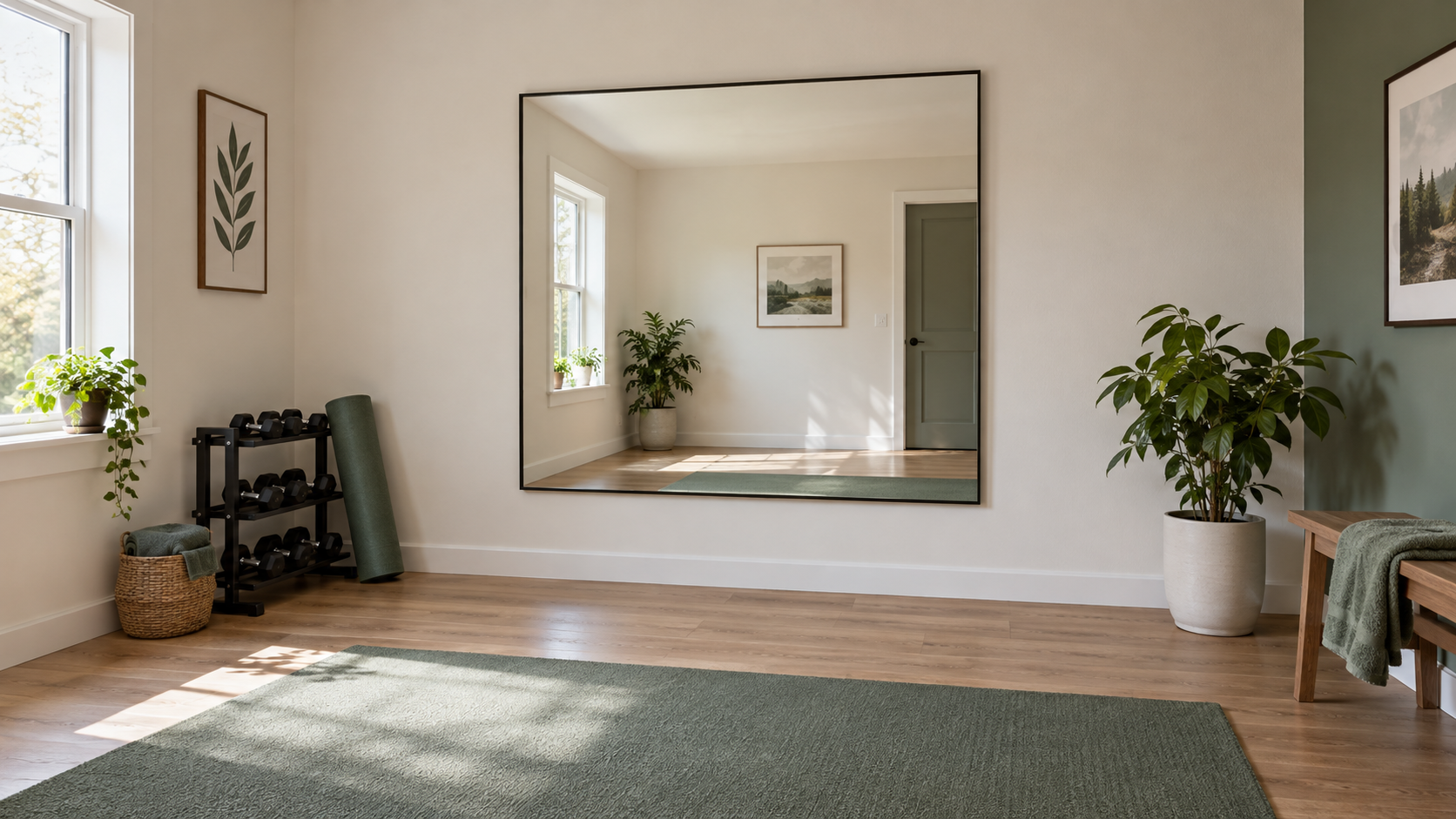
A home gym mirror should help you use the room, not just make a blank wall look finished. Before choosing a large panel, decide what you want to see, where you will stand and whether equipment or reflected light will interfere with the view. A smaller, well-positioned mirror can be more useful than a full wall in the wrong place.
This home gym mirror placement checklist is a planning guide, not a glass-installation tutorial. Have the supplier or a qualified installer confirm the glass, fixing system and wall suitability for your exact product.
Start with the view you actually need
Write down the activities for which a mirror would be useful. A standing view, a seated view and a floor-level view are different requirements. Mark your usual positions on a room sketch, then look toward the proposed wall from each position. A panel hidden behind a machine will not become useful simply because it is large.
A mirror is also optional. If you find reflections distracting, or the only available wall is unsuitable, leave it out. It cannot replace instruction from a qualified trainer, and you should not twist your head during a loaded movement to watch yourself.
Make a paper outline before ordering glass
Sketch the proposed panel on a photograph of the wall, or use removable paper markers on a surface where they will not damage the finish. Note the width and height, nearby switches, sockets, vents and any door that opens toward the wall. The outline checks the visual scale; it does not prove the wall can carry the mirror.
Ask another person to stand at the proposed viewing position while you discuss what needs to be visible. For precise sightlines, ask the supplier or installer to help determine the panel dimensions. Do not order solely from a decorative room photograph.
Keep equipment movement separate from the mirror
Think beyond the equipment’s parked footprint. Benches move, handles travel and storage drawers open. Record the full operating area and the manufacturer’s required clearances. Keep the proposed mirror away from likely contact with weights, moving equipment and passing people; glass safety features do not make impacts harmless.
If your layout is not settled, start with our home gym space-planning guide. Resolve the equipment arrangement first, then choose the mirror position around it.
Check reflections at your usual workout time
Look at the wall during the hours you normally use the room. A window opposite the mirror may create a bright reflection, while a ceiling fitting may appear directly in your line of sight. Consider where a screen will sit as well: reflecting a bright display can make the room feel busier without adding useful visibility.
Review the lighting and mirror together rather than treating them as separate purchases. Our low-ceiling lighting guide covers the related room-planning questions.
Give the installer a clear brief
Use this short handoff when asking for a quote:
- Wall location, photographs and approximate panel dimensions.
- Known wall construction and any uncertainty that needs inspection.
- Nearby doors, outlets, equipment and access restrictions.
- The views you need from standing, seated or floor positions.
- Questions about safety backing, edge treatment and product suitability.
- Who supplies the approved fixings, installs the panel and removes packaging.
Product instructions matter. For example, Dulles Glass publishes a gym-mirror installation guide; use the instructions for the product you actually buy rather than transferring a fixing method from a different mirror. Avoid improvised adhesive-only installations or leaning an unsecured mirror in the exercise area.
A simple decision example
Imagine a spare room with a clear front wall, a bright side window and dumbbell storage beside the door. A proposed wall-wide mirror would extend behind the storage and into the door area. A narrower panel on the clear section may provide the needed view with fewer conflicts. That is a layout decision to discuss with the installer, not a universal panel-size recommendation.
Before you approve the order
Confirm the useful viewing area, glare, equipment clearance, delivery route and installation responsibility. Keep the product instructions with your room records. The best result is a mirror that fits the way you use the gym without forcing you to compromise the rest of the room.
Leave a Reply