
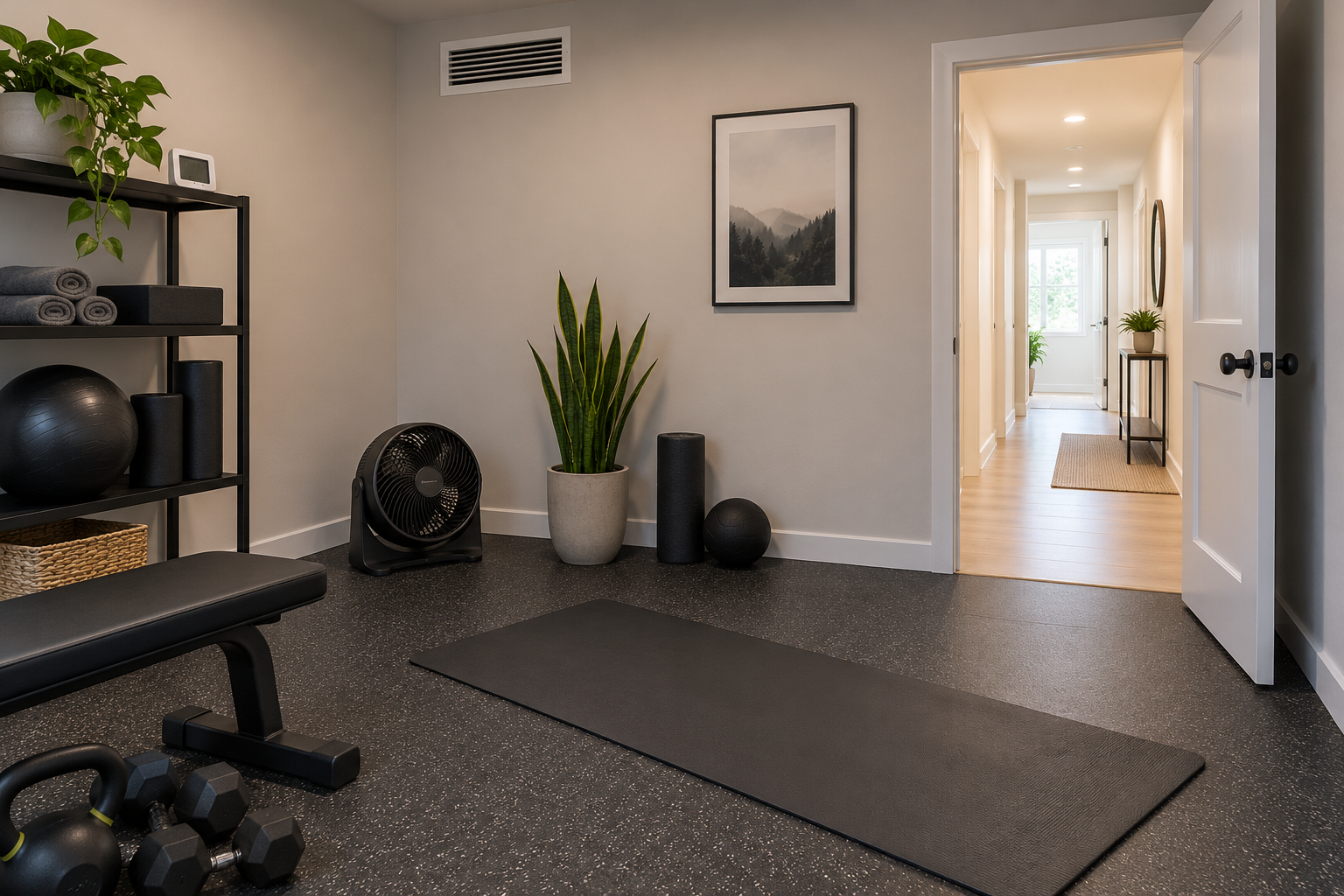
A windowless home gym can work well, but the room needs more than a fan pointed at the treadmill. During a workout, heat, moisture and odors build up quickly. The goal is to bring cleaner air into the room, move stale air out, and keep humidity under control—without turning the space into a noisy wind tunnel.
This guide explains a practical way to improve airflow in a basement, garage, spare room or converted storage area with no exterior window. Start with the simplest changes, then move to mechanical ventilation if the room still feels hot or stale.
First, understand what each device actually does
Ventilation, air circulation, filtration and dehumidification solve different problems:
- Ventilation exchanges indoor air for outdoor air.
- Circulation moves air around the room but does not add fresh air by itself.
- Filtration captures particles that pass through a filter.
- Dehumidification removes moisture from the air.
A portable fan can make exercise feel more comfortable, but it cannot replace fresh-air ventilation in a closed room. Likewise, a dehumidifier can reduce dampness, but it does not remove every indoor pollutant or supply oxygen. The US Environmental Protection Agency describes source control, adequate ventilation and supplemental filtration as three core ways to improve indoor air quality, and recommends keeping indoor humidity below 60%, ideally in the 30–50% range. See the EPA’s indoor-air guidance.
Step 1: create a clear air path through the doorway
In many small gyms, the doorway is the easiest route for air exchange. Keep it open during and for a while after training when privacy and household conditions allow. Then place a fan so it supports a deliberate path instead of stirring the same pocket of air.
Try positioning the fan a few feet inside the gym, aimed out through the doorway. This pushes warmer, humid air toward the hall and encourages replacement air to enter around it. If the connected hall has an open exterior window or a properly vented exhaust fan, the effect is stronger. Avoid blocking the doorway with a bench, storage rack or stacked mats.
For a very small room, one quiet floor fan may be enough to improve comfort. In a longer room, a second low-speed fan can help move air from the far corner toward the exit. Keep cords away from walkways and moving equipment.
Step 2: use an exhaust fan that vents outdoors
If the room remains stuffy, the most useful upgrade is usually a mechanical exhaust path to the outside. A wall- or ceiling-mounted exhaust fan can remove warm, moisture-laden air, but it must discharge outdoors—not into an attic, wall cavity or another closed room.
Air that leaves also needs a way to return. A door undercut, transfer grille or dedicated make-up-air path can prevent the fan from struggling against a sealed room. An HVAC contractor can size the system for the room and check whether a nearby duct can be used safely. Local building rules may govern new wall penetrations, electrical work and ventilation near fuel-burning appliances.
Do not improvise around furnaces, water heaters or other combustion equipment. Strong exhaust can affect pressure in the room and, in some layouts, contribute to backdrafting. If the gym shares space with combustion equipment, ask a qualified professional to assess the ventilation plan.
Step 3: manage humidity after every workout
Moisture often causes the first noticeable problems: a persistent smell, condensation on cool surfaces, or damp rubber flooring. A small digital hygrometer gives you a better signal than guessing. Check the reading before training, near the end of the session and 30 minutes later.
If humidity regularly stays above the recommended range, use a properly sized dehumidifier and keep its filter and drain clean. A continuous drain is convenient where a suitable drain point exists. Emptying a bucket late or letting a filter clog reduces the benefit.
Simple habits matter too: hang towels to dry outside the gym, wipe sweat from benches and mats, and avoid storing damp clothing in a closed hamper. Leave space between flooring and walls where the product instructions require it, and investigate any water intrusion before covering the area with new flooring.
Step 4: add filtration for particles, not as a substitute for fresh air
A portable air cleaner can help capture dust and other airborne particles. Choose a unit sized for the room, place it where air can move freely around the intake and outlet, and follow the manufacturer’s filter-replacement schedule. A machine hidden behind a sofa or squeezed between storage bins will not work as effectively.
Filtration is especially useful when the gym shares air with pets, a workshop or a dusty basement. It still does not replace outdoor-air exchange. Think of it as one part of the plan, not the whole plan.
Step 5: reduce heat and moisture at the source
Some comfort improvements do not require another appliance. Train at a cooler time of day, switch heat-producing lights to efficient LEDs, and turn unnecessary electronics off. Clean dust from equipment and vents. If the room contains a clothes dryer, sink, sauna or shower, deal with those moisture sources separately.
Equipment placement also changes airflow. Keep tall shelving and large machines away from supply grilles, returns and the doorway. Before rearranging a tight room, use our room-by-room home gym space guide to preserve safe working clearances.
A simple setup for three common rooms
Windowless spare room
Open the door, run a quiet fan toward the hall, and use the home’s normal HVAC supply and return if the system was designed for that room. Add a hygrometer and use a portable air cleaner when particle control is useful.
Basement gym
Prioritize moisture control and check for leaks or condensation. Use a dehumidifier where needed, maintain a clear route to the stairwell, and consider a professionally installed outdoor exhaust if stale air persists.
Garage gym
Open the main door only when security, weather and outdoor air quality make it sensible. Never run a vehicle in the space while exercising, even with the door open. Store fuels, solvents and strong chemicals away from the training area.
How to tell whether the plan is working
After two weeks, look for practical changes: the room cools down faster, humidity returns toward its starting level, odors do not linger, and surfaces stay dry. If the room still feels unusually stuffy, you see recurring condensation or mold, or anyone experiences persistent symptoms while using it, stop and get advice from an appropriate HVAC, building or health professional.
For a quieter setup, combine low-speed airflow with stable equipment placement and the ideas in our guide to reducing home gym noise and vibration.
Quick checklist
- Keep a clear path from the far side of the room to the doorway.
- Use fans to support that path, not just to blow at one person.
- Vent exhaust air outdoors and provide replacement air.
- Track humidity with a hygrometer.
- Use filtration for particles and a dehumidifier for moisture.
- Keep vents, returns and equipment clear.
- Call a professional when combustion appliances or building work are involved.
A good windowless-gym setup is not complicated for the sake of it. It is a small system in which each part has a clear job: fresh air comes in, stale air gets out, moisture is controlled, and the room remains comfortable enough to use consistently.
Leave a Reply