
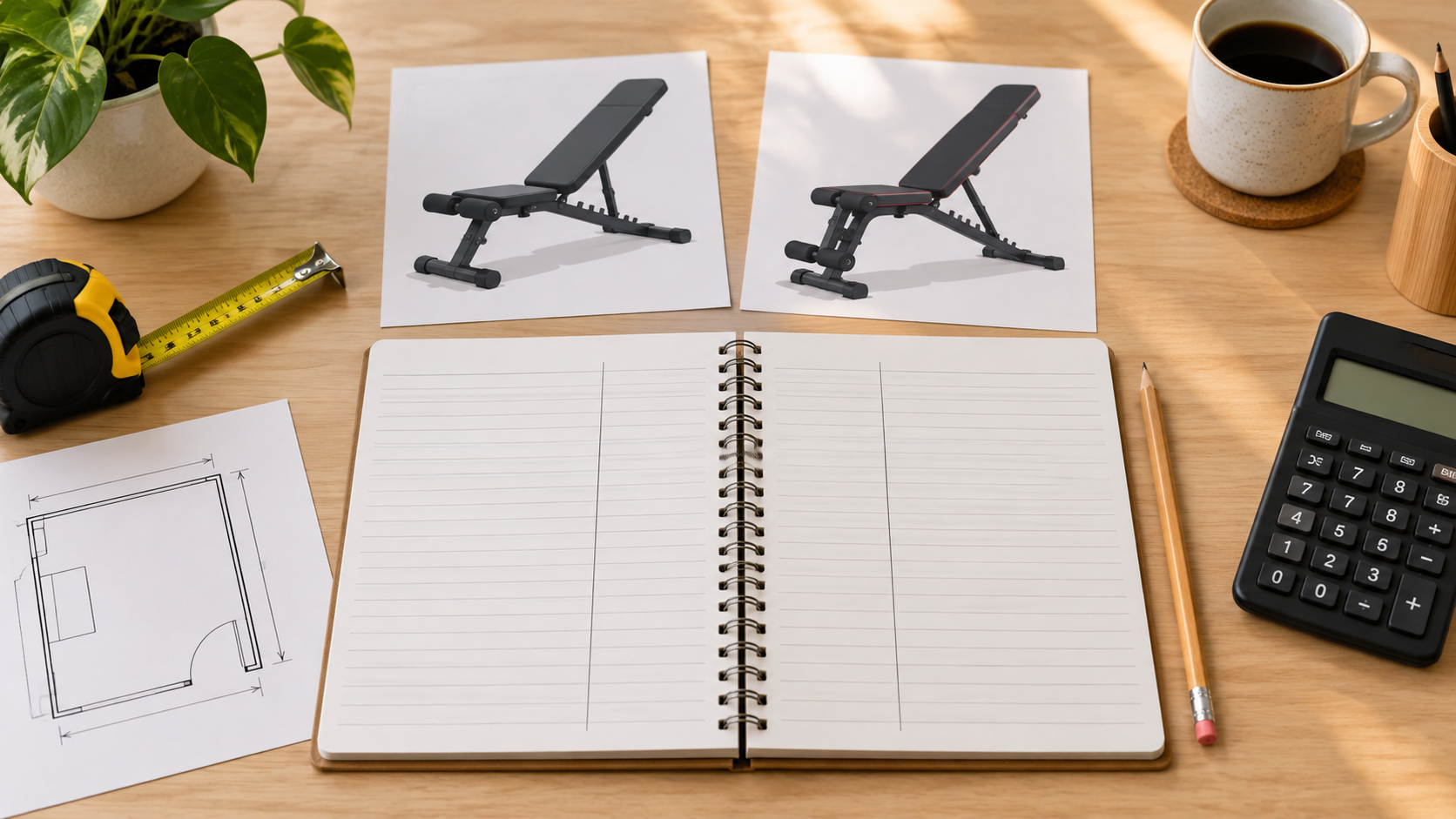
Two pieces of home gym equipment can look similar online and create very different experiences at home. One may fit the room but be awkward to move; another may have a lower price but require accessories you have not included. A home gym equipment comparison worksheet keeps those trade-offs visible before you buy.
This is a purchasing and space-planning tool, not an exercise prescription or a product test. Use current manufacturer instructions and retailer terms for the exact model you are considering. Leave an unknown field blank and ask a question rather than guessing.
Compare equipment that serves the same purpose
Start by writing the job you need the equipment to do. “A compact option for the exercises I already practise” is more useful than “something for fitness.” Avoid comparing a large multi-station machine with a small accessory simply because both appear in a sale.
Choose two or three realistic candidates. Include the option of keeping what you own or delaying the purchase. If none fits your space, budget and intended use, the worksheet has done its job by helping you avoid a poor match.
Create a separate column for each model
Record the exact model name, product link, seller and date checked. Similar names can conceal different versions, accessories or warranty terms. Then add these rows:
- Intended use: the specific task the equipment needs to support.
- In-use dimensions: equipment size plus the operating clearances specified in its instructions.
- Stored dimensions: folded or packed size, where relevant.
- Setup and moving: steps required, lifting needs and who will do them.
- Delivery and assembly: route, service offered and any extra charges.
- Total initial cost: item, required accessories, delivery and assembly.
- Ongoing requirements: maintenance, consumables and optional or required subscriptions.
- Support: written warranty, returns process and availability of replacement parts.
- Open questions: missing information that could change your decision.
Record the source next to important specifications. A retailer summary and the manufacturer’s current manual may differ. Resolve the difference before ordering rather than selecting whichever figure makes the purchase easier.
Use a pass-or-hold check before scoring features
Some conditions are not trade-offs. An item that cannot pass through the delivery route should not win because its screen is better. Mark essential requirements as confirmed, not confirmed or unsuitable. Hold the decision if a critical requirement is unresolved.
Check the operating space rather than only the footprint shown in a product photograph. Also consider storage access and whether the setup blocks a door or shared walkway. Our equipment delivery checklist covers route measurements in more detail.
Do not use a comparison score to certify floor loading, electrical suitability or installation safety. Follow the manufacturer’s requirements and seek qualified advice when those conditions are uncertain.
Separate purchase price from practical cost
Put each cost on its own line. If one candidate includes delivery and another does not, the headline prices are not directly comparable. Note whether assembly, a compatible accessory or a subscription is necessary for the feature you actually want.
Do not treat an optional subscription as compulsory, or assume a trial will remain free. Check current terms and record renewal costs where relevant. Return shipping for a bulky item may also matter; read the seller’s policy before buying rather than relying on a generic “easy returns” badge.
A fictional comparison example
Imagine two folding exercise benches for a shared room. Candidate A has a lower listed price but its folded dimensions are not confirmed. Candidate B costs more and has documented storage dimensions. Both still need their intended-use limits, operating space and assembly instructions checked.
The useful conclusion is not “B is best.” It is “Ask for A’s folded dimensions, then compare both against the actual storage space.” If A will not fit, its lower price does not solve the problem. If both fit, setup effort and total cost can inform the next decision. These candidates are illustrative, not tested products.
Try a realistic setup rehearsal
Before ordering, walk through where the item will live and how the room will change during use. Can you access the storage position without moving several other objects? Where will packaging, accessories and instruction manuals go? Does another person use the same room at the same time?
A paper outline can help visualise a footprint, but it cannot reproduce the equipment’s stability, moving parts or full range of use. Treat it as an early planning aid, not a safety approval. Our small-room equipment storage guide offers ways to think through shared-space organisation.
Write the reason for your final choice
Finish the worksheet with a short decision note: what you chose, which requirements were confirmed and what compromise you accepted. Keep the dated specifications and order details. This is more useful later than a single unexplained score.
You can also decide not to buy. If the main advantage is a feature you are unlikely to use, waiting may be the more practical result. The worksheet is there to clarify the decision, not justify a purchase already made in your head.
Common questions
Should I give every feature a numerical score?
Only if it makes the decision clearer. Confirm essential requirements first. A high total should never cancel an unresolved fit or installation requirement.
Can reviews replace the manufacturer’s manual?
No. Reviews may raise useful questions, but confirm specifications, intended use and installation instructions for the exact model with the manufacturer.
How often should I update the worksheet?
Check it again before ordering if time has passed, the seller changes or a new model version appears. Prices, stock and purchase terms can change.
Leave a Reply