
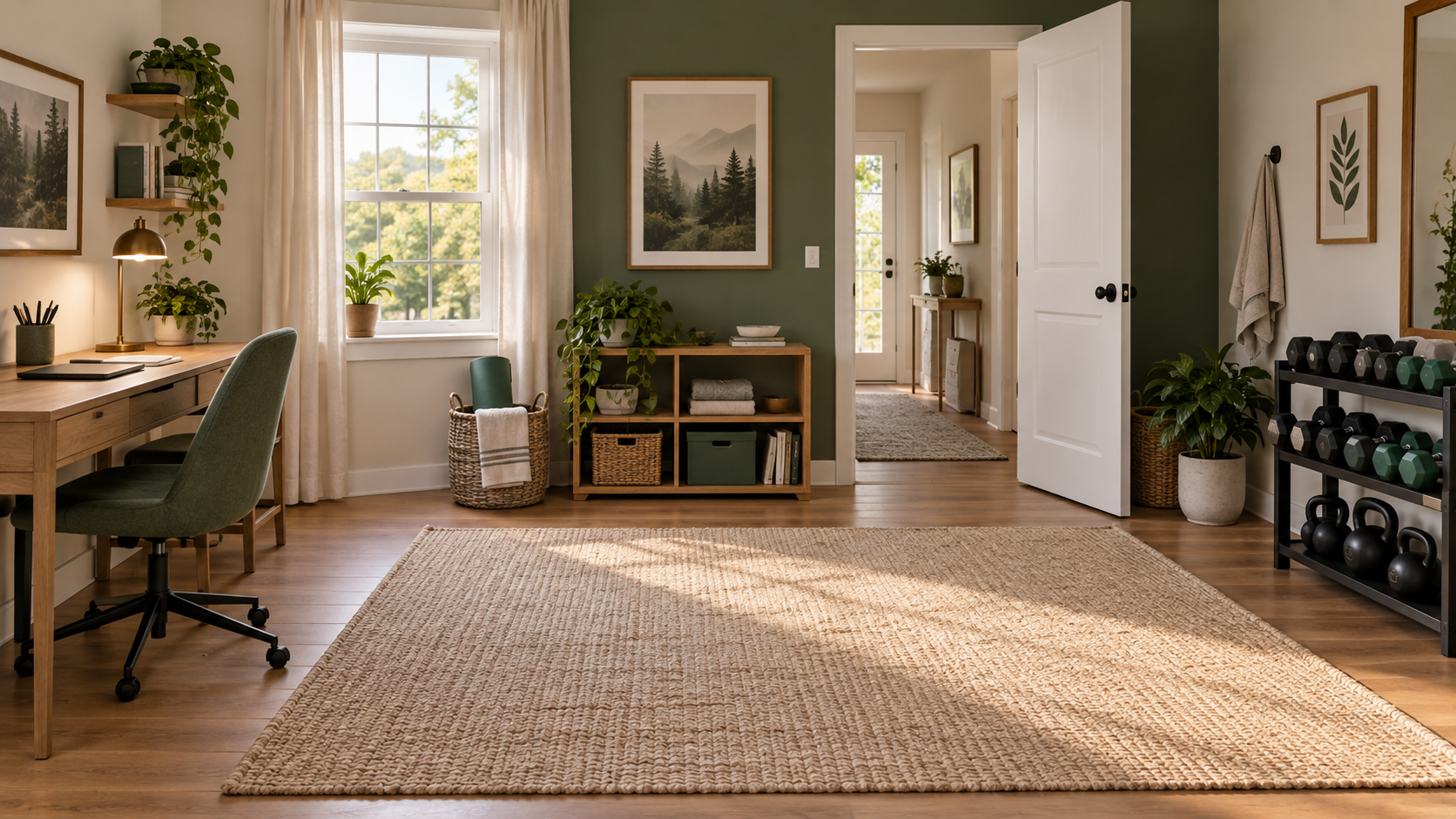
A shared home gym works best when everyone knows how to leave the room ready for the next person. Buying more equipment will not solve a bench blocking a desk, missing accessories or two people expecting to use the same space at once. A simple room plan and a short reset routine are often a better starting point.
This guide is for households sharing a workout area with each other or with another activity. It is an organisation plan, not exercise instruction or a substitute for equipment safety requirements.
List the room’s jobs before moving anything
Write down every real use of the space: training, working, laundry, guests or general storage. Then separate fixed commitments from flexible ones. A weekday video meeting at a desk may be fixed; storing an unused box in the same corner may not be.
Ask each user what makes the room difficult to use now. One person may need a clear floor, while another needs a place for small accessories. Avoid assuming that the person with the most equipment should make every layout decision. The aim is a room that can be reset reliably, not a perfect photograph.
Draw a ready-to-use layout and a parked layout
Create two simple sketches. The first shows equipment in use with the operating clearances required by its manufacturer. The second shows where movable items belong when the room returns to its other purpose. Include doors, cupboards and the route through the room in both sketches.
Do not treat a machine’s footprint as its complete space requirement. Follow the manual for access, movement and clearance. Only fold or move equipment designed for that purpose, using its stated procedure. If changing between layouts requires awkward heavy lifting every day, reconsider the arrangement rather than making that lift part of the routine.
Our guide to storing workout equipment in a small living room offers a starting point for deciding which items need a permanent home.
Give accessories a specific home
A label such as “small accessories” is useful only if the container is easy to reach and large enough for what belongs inside. Group related items and avoid stacking frequently used pieces under rarely used ones. Choose storage appropriate for the weight and size of the equipment; an ordinary decorative shelf is not automatically suitable for weights.
Keep personal items separate from shared equipment if that prevents confusion. A small labelled pouch for each person’s headphones or notebook may be enough. Put manuals and purchase records somewhere accessible, but avoid leaving papers in the workout area. Use an inventory to identify duplicates before adding another storage unit.
Agree on a lightweight booking rule
A shared calendar can help if people regularly clash, but it need not become a complicated booking system. Start with a few protected periods for work or other commitments, then note the workout times that genuinely require exclusive use.
For example, a household might reserve the room for desk work until 5 pm and agree that anyone using equipment afterwards leaves it in the parked layout before bedtime. That is an illustrative arrangement, not a recommended training schedule. Choose times that match your household, and agree how to communicate a change.
If two people want to use the space together, do not assume that their individual layouts can simply overlap. Check the equipment instructions and the clear space needed for each activity. Where the room cannot accommodate both safely, use it at different times.
Make the end-of-session reset short and visible
Place a concise reset checklist near the storage area. Keep it focused on actions that matter rather than adding tasks nobody will maintain:
- Return accessories to their labelled storage.
- Follow the manufacturer’s shutdown and storage instructions for equipment used.
- Clean shared surfaces using the methods and products allowed by the equipment instructions.
- Leave the agreed walkway, doors and work area clear.
- Record a missing part, unusual behaviour or damage rather than leaving the next person to discover it.
A reset is not a technical inspection. If equipment appears damaged or behaves unexpectedly, stop using it and follow the manufacturer’s support and service guidance. A note to the household helps communicate the problem; it does not make the equipment safe to use.
Use one shared issue log
Keep a short record with the item, the observation, the date and the next action. Write what happened rather than guessing a diagnosis: “adjustment knob did not tighten normally” is more useful than “probably fine.” Add who is following up so the same task is not forgotten or repeated.
For a fuller record, use our home gym maintenance log template. Manufacturer-specified checks and service intervals take priority over any household reminder schedule.
Review the arrangement after a normal week
Notice where items accumulate, which transitions take too long and whether anyone keeps moving the same object. Change one source of friction at a time. Moving a frequently used storage box may help more than rearranging the whole room.
Keep what works and remove rules that add effort without solving a problem. The useful measure is whether everyone can find what they need and return the room to its agreed state—not whether every surface looks empty.
Common questions
Do we need separate equipment for each person?
Not necessarily. Start with what is already available and suitable for each user’s needs. Record required adjustments and follow equipment instructions; do not share equipment when its use or fit is inappropriate.
What if the room is also a guest room?
Plan the guest layout in advance and decide which equipment can be stored safely elsewhere. Avoid improvising heavy moves when guests arrive. If the room cannot serve both purposes sensibly, reduce the amount of equipment kept there.
Should we buy storage before planning the layout?
Measure and list the items first. The best storage choice depends on the equipment, its weight, access needs and the space available—not just the appearance of the organiser.
Leave a Reply