
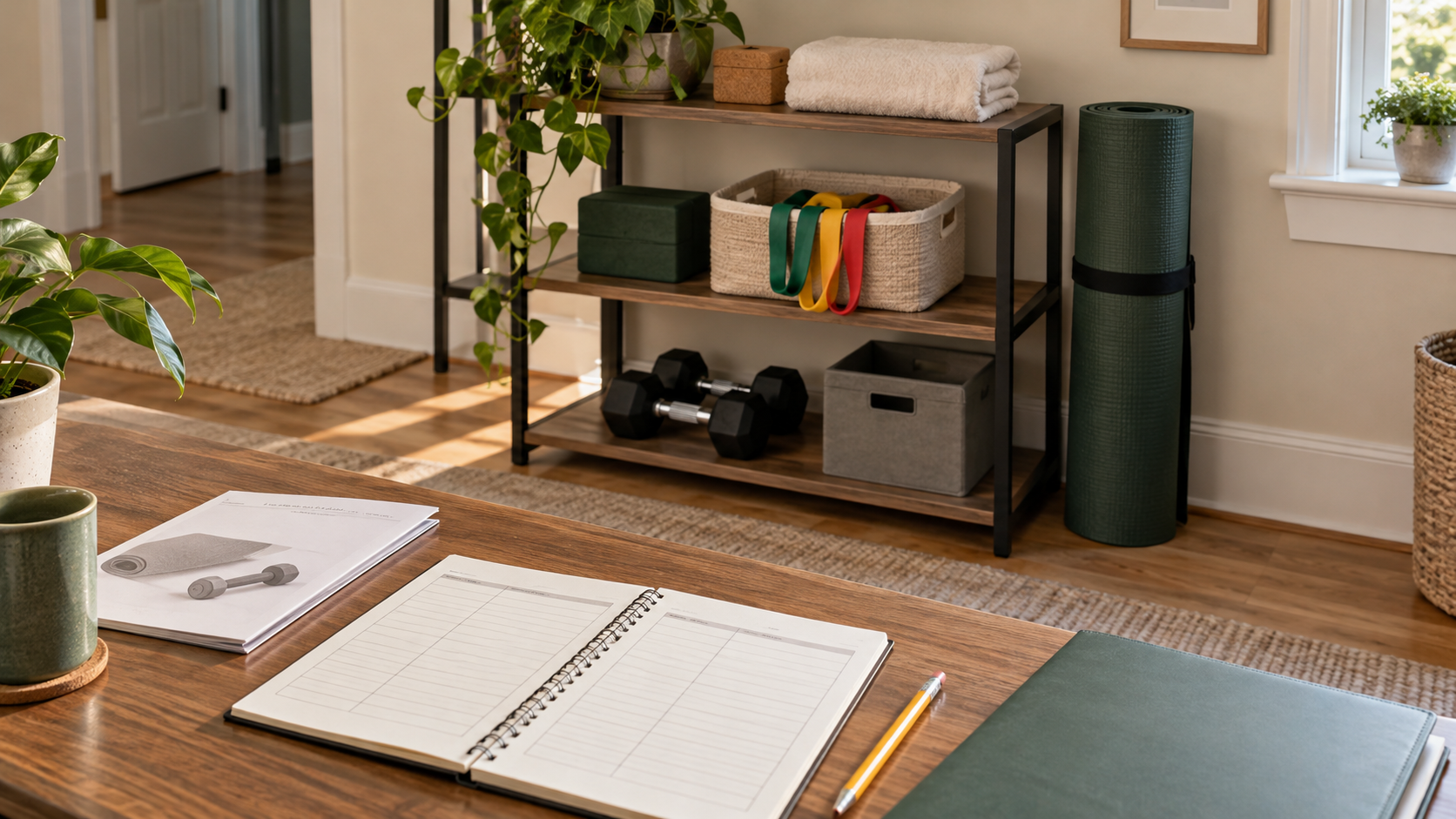
Before adding another piece of equipment to your home gym, take stock of what is already there. The spare resistance band in a drawer, the attachment in its original box and the mat behind a door are easy to forget when you are comparing new products.
A home gym equipment inventory template gives those items one reliable home on paper. This guide includes a copyable record and a simple buying-decision process. It is an organisation tool, not a workout prescription or a safety inspection.
Start with what you own, not what you want
Walk through the places where you keep exercise equipment. Check cupboards, storage boxes and shared rooms as well as the main workout area. Record one item or clearly defined set at a time. Keep your wish list separate so planned purchases are not mistaken for equipment you already have.
Be specific about quantities. “Dumbbells: two pairs” is less useful than listing each pair and its marked weight. For adjustable equipment, record the model and the range stated on the product or manual rather than estimating from appearance.
You do not need to move heavy equipment to complete the list. Record information you can access safely and leave a note where a model label is difficult to reach.
The fields worth keeping
- Item and model: the product name and model, if available.
- Quantity or set: whether you have one item, a pair or a complete set.
- Marked specification: weight, size or model-specific detail that helps distinguish it.
- Storage location: a location another household member could understand.
- Associated accessories: parts supplied with it and where they are stored.
- Documentation: a link or location for the manual and receipt.
- Open question: anything that needs checking before use or purchase.
- Next action: the person responsible and a target date, if useful.
Keep receipts and serial numbers in a private record. If you share a public photograph of your setup, there is no need to expose those details alongside it.
A copyable inventory card
Copy the following into a note, spreadsheet or printed sheet. Repeat it for each item rather than creating a complicated system you will not maintain.
Item/model: ______
Quantity/set: ______
Marked specification: ______
Stored in: ______
Accessories and their locations: ______
Manual/receipt location: ______
Last used for: ______
Question to resolve: ______
Next action and date: ______
“Last used for” can be a short practical note, such as a regular routine or a class you follow. You do not need to record personal health information, detailed training data or a perfect usage history to make the inventory useful.
A fictional example: one item, one useful decision
Imagine a household owns an exercise mat stored behind the bedroom door. Its inventory card says the mat is used for an online class, but the owner has been shopping for another mat because the first is awkward to retrieve.
The problem may be access rather than a missing product. Before buying, the owner can decide whether a better storage location would solve it. In a different household, two people may genuinely need separate mats at the same time. The inventory does not dictate the answer; it makes the reason for buying clearer.
Separate missing parts from missing equipment
An unused machine might be waiting for a manual, a supplied accessory or advice from its manufacturer. Mark the unresolved issue instead of simply labelling the item “not useful.” Do not assume a similar-looking replacement part is compatible.
If you notice damage or have a safety concern, stop using the affected equipment and consult the manufacturer’s instructions or qualified support. A tick in an inventory is not evidence that equipment is safe, and this template should not replace inspection or maintenance requirements.
Use three questions before making a purchase
- What specific need will this item address? Write the intended use in plain language.
- Does something already owned serve that need? Compare the actual function, not just the product category.
- What else must be arranged? Consider storage, delivery access, required clearances and any compatible accessories.
Keep a separate “considering” list with those answers. An item can remain on that list until the unanswered questions are resolved. There is no need to turn every gap into an immediate purchase.
For a larger order, use the equipment delivery checklist before assuming the packages will reach the room. Review the home gym space-planning guide alongside the exact manufacturer’s installation requirements.
Give each item a clear storage location
Use labels such as “hall cupboard, lower shelf” rather than “somewhere upstairs.” Group small accessories with the equipment they belong to, without storing them in a way that damages them or creates a trip hazard. Follow the manufacturer’s storage instructions.
If your gym shares a living space, the small living-room equipment storage guide can help you think about access and tidy storage. The inventory records where things belong; it does not require a new shelving system.
Update the list when something changes
Add an entry when equipment arrives. Amend it when an item moves, is sold or is replaced. If someone borrows an accessory, note that temporarily so it does not appear to be missing. A brief review before the next purchase is usually more practical than creating daily paperwork.
The goal is a clearer picture of your own setup. When you know what you have, where it lives and what remains unresolved, the next purchase becomes a considered decision rather than a guess.
Leave a Reply