
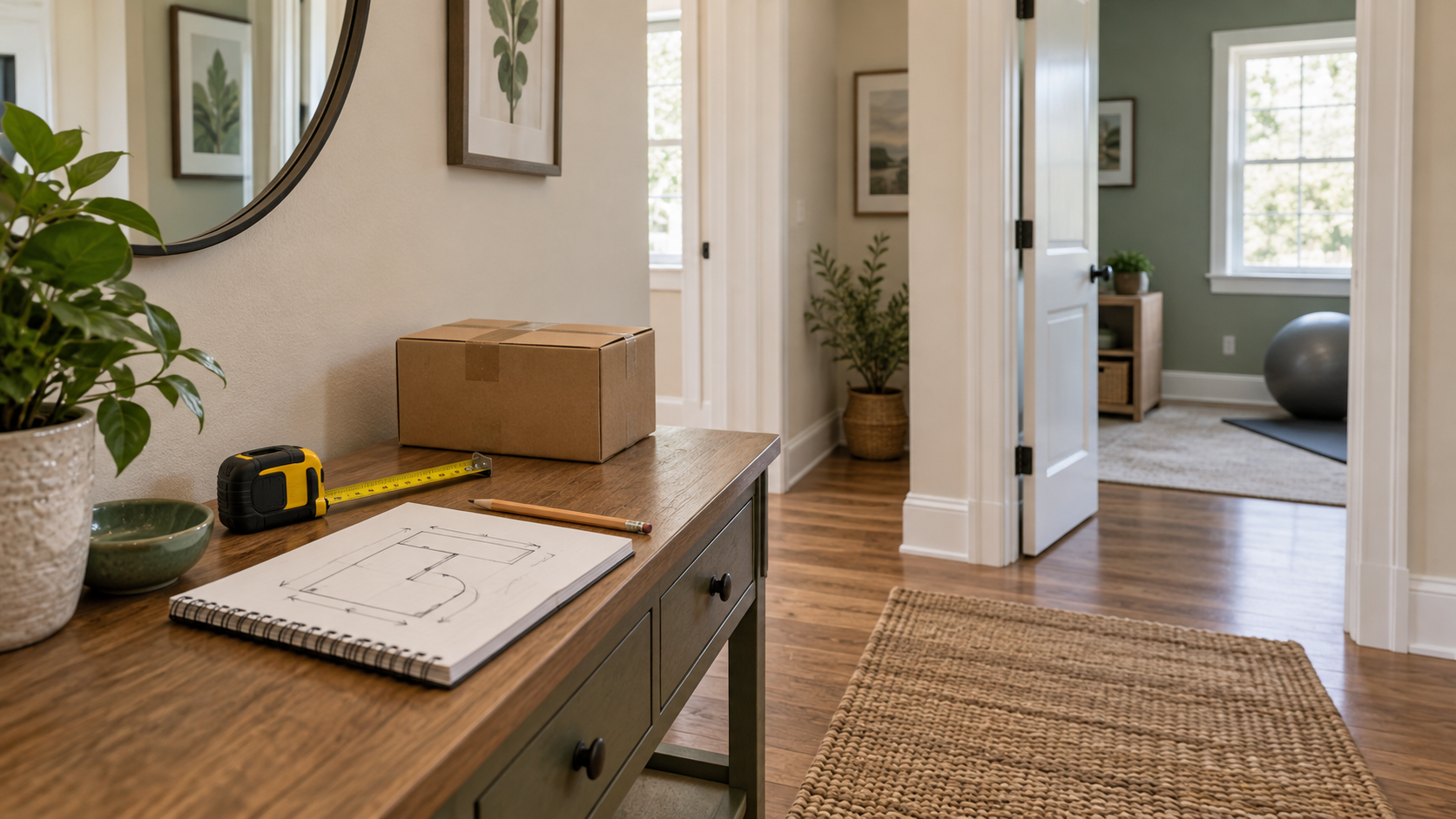
A treadmill can fit neatly in your planned workout area and still fail to get through the front door. Before ordering a large piece of equipment, check two separate things: the space it needs when installed and the route its delivery packages must travel to reach that space.
This home gym equipment delivery checklist helps you collect the measurements and delivery details that are easy to overlook. It is a planning guide, not instructions for lifting heavy equipment or a substitute for the product’s installation manual.
1. Identify exactly what will arrive
Start with the precise model and version, not a photograph of a similar machine. Ask the seller for the dimensions and weight of each shipping package. Then record the assembled dimensions separately. Folded dimensions are a third measurement: they describe storage, not necessarily the delivery box.
For example, Horizon Fitness lists shipping-box and assembled measurements separately for its treadmills. That distinction is useful when comparing any equipment, but use the specifications for your exact purchase rather than borrowing another model’s figures.
- Product name, model number and link to its manual.
- Number of packages and dimensions of every package.
- Weight of each package, including the heaviest one.
- Whether the supplier requires the equipment to stay packaged until it reaches the installation area.
- Whether assembly is included and who is responsible for it.
2. Walk the entire delivery route
Walk from the expected unloading point to the final room. Include gates, shared entrances, corridors and internal doors. A wide front door does not solve a tight turn farther inside.
Measure the usable opening rather than the outside of the door frame. Note obstructions such as fixed handles, radiators and stair rails. For a corridor with a turn, record both corridor widths and the available turning space. Straight-line width alone does not prove that a long box can turn a corner.
Do not assume a delivery team will remove doors, railings or packaging. Ask the provider to assess any difficult access using your measurements and photographs before you place the order. Never remove structural or safety features to make a delivery fit.
3. Check stairs, lifts and building rules
In a flat or shared building, contact the building manager about delivery hours, lift reservations and access restrictions. Record the lift’s clear door opening, cabin dimensions and stated load limit. The delivery provider must decide whether the proposed method is suitable; a box fitting inside the cabin is not enough by itself.
Describe staircases accurately, including turns, landings and the destination floor. If access is uncertain, obtain written confirmation from the delivery or installation provider. Do not plan on improvising a lift with friends when the driver arrives.
4. Confirm what the delivery service actually includes
Terms such as doorstep, room-of-choice and installation describe different services. Ask where the order will be left, whether stairs are included, whether assembly is included and whether packaging will be taken away. Also ask what happens if access is unsuitable.
Horizon Fitness’s US delivery guidance illustrates why delivery tiers need checking. Do not assume those arrangements apply to another retailer, country or order. The terms confirmed for your purchase are the ones that matter.
A copy-and-use delivery worksheet
- Largest package: length ___ × width ___ × height ___; weight ___.
- Narrowest opening: location ___; clear width ___; clear height ___.
- Most difficult turn: location ___; measurements and photos sent ___.
- Stairs or lift: details ___; provider approval received ___.
- Service level: drop-off location ___; assembly ___; packaging removal ___.
- If access fails: agreed next step ___; potential charges checked ___.
Use the same units throughout. Keep the supplier’s written answers with the order confirmation so that everyone is working from the same information.
5. Check the final installation area separately
Once the route is confirmed, review the manufacturer’s required operating clearances, power requirements and permitted installation conditions. A machine’s footprint does not include all the space needed to use it safely. Our home gym space-planning guide can help you organise the room, but the exact product manual takes priority.
Renting? Check your tenancy and building rules before committing to a large installation. The renter-friendly setup checklist covers removable arrangements without assuming permanent alterations are allowed.
Before you press buy
Pause if any critical measurement is missing or the seller cannot confirm difficult access. A smaller machine, different room or professional installation service may be a better choice. The useful question is not just “Will it fit in my gym?” It is “Can the agreed delivery team get this exact order into that room using an approved plan?”
Leave a Reply